
One of my favorite topics to teach others in our workshops is that of mindset. Specifically, we engage people in the mindset for innovation and even more specifically…the mindsets for design thinking. The most popular mindset research was done by Carol Dweck of Stanford. It is excellent…and focuses on a fixed vs. growth mindset.
This guide explains the difference between a fixed mindset and a growth mindset, shows what each looks like at work and in school, and includes a simple infographic you can share with your team or students.
Growth vs. fixed mindset infographic
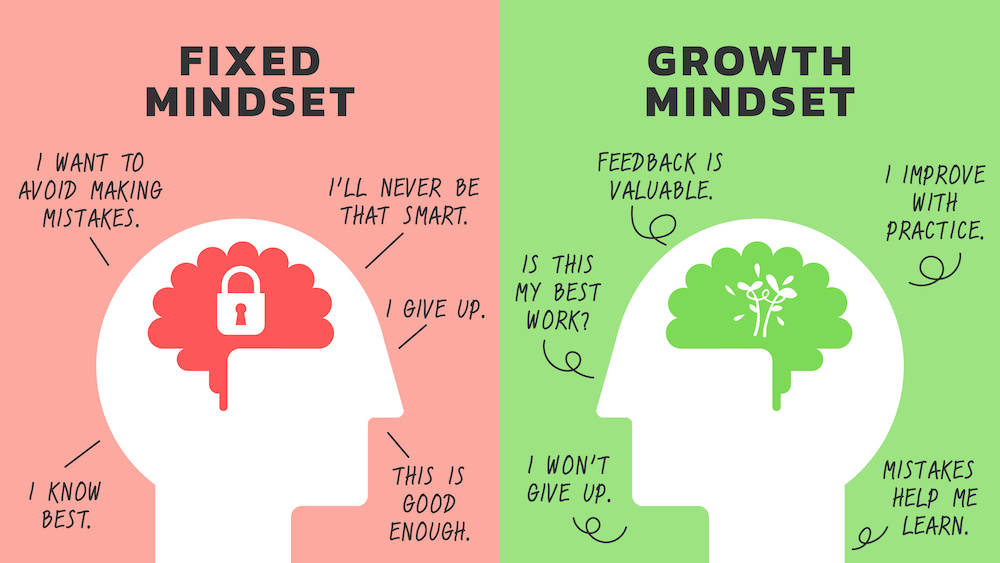
What is a fixed mindset?
A fixed mindset is the belief that intelligence, talent, and abilities are set traits that can’t change much. People operating from a fixed mindset tend to see a challenge as a test of how capable they already are. Because of that, mistakes and criticism can feel like proof of a permanent limitation, so it becomes tempting to avoid hard tasks, hide errors, or give up when progress is slow.
What is a growth mindset?
A growth mindset is the belief that abilities can be developed through effort, good strategies, practice, and help from others. People operating from a growth mindset see challenges as chances to learn. They treat mistakes and feedback as useful information and are more willing to stick with difficult work.
The terms come from the research of Stanford psychologist Carol Dweck, popularized in her book Mindset: The New Psychology of Success. Dweck has also emphasized that no one has a pure growth or fixed mindset. Everyone is a mix, and specific situations, such as a tough deadline or a new skill, can trigger fixed-mindset reactions in anyone.
Growth mindset vs. fixed mindset: key differences
| Situation | Fixed mindset | Growth mindset |
|---|---|---|
| Beliefs about ability | Intelligence and talent are fixed | Abilities can be developed |
| Challenges | Avoids them to avoid looking incapable | Takes them on as a way to improve |
| Obstacles | Gives up easily | Persists and tries new strategies |
| Effort | Sees effort as a sign of low ability | Sees effort as the path to mastery |
| Mistakes | Hides or explains them away | Examines them to learn |
| Feedback | Ignores or takes it personally | Asks for it and uses it |
| Success of others | Feels threatened | Finds lessons and inspiration |
Fixed mindset and growth mindset examples
The difference often shows up in the small things people say to themselves. Here are common examples:
| Fixed mindset thought | Growth mindset alternative |
|---|---|
| “I’m just not a creative person.” | “Creativity is a skill I can practice.” |
| “This is too hard.” | “This will take more time and a different approach.” |
| “I made a mistake, so I’m bad at this.” | “What can this mistake teach me?” |
| “They’re naturally better than me.” | “What are they doing that I could learn from?” |
| “I’ll never be good at presenting.” | “I’m not good at presenting yet.” |
Why mindset matters for innovation and teams
Innovation depends on trying things that might not work. Teams need to share rough ideas, test early prototypes, and hear critical feedback without shutting down. A fixed mindset makes all of that feel risky, while a growth mindset makes experimentation feel normal. That is why mindset is a core part of design thinking and innovation training: before people can use new methods, they need to believe they can learn them.
Leaders influence this too. When managers praise effort and learning, share their own mistakes, and treat failed experiments as useful data, teams are more likely to take smart risks.
How to develop a growth mindset
- Notice your fixed-mindset triggers. Pay attention to the situations that make you defensive or discouraged, such as criticism, comparison, or a new skill.
- Add the word “yet.” “I can’t do this yet” turns a verdict into a starting point.
- Focus on process, not just results. Recognize strategies, effort, and improvement, in yourself and others.
- Treat feedback as information. Ask what specifically would make the work better.
- Run small experiments. Try a new approach on a low-stakes task and reflect on what you learned.
- Reflect regularly. A short reflective practice helps turn experiences into lessons.
Learn more
To go deeper, explore this list of top growth mindset books and these growth mindset training resources. To build a growth mindset across your team or organization, consider a hands-on growth mindset workshop.