Incremental or Breakthrough Innovations: Go +1 or x2?

incremental versus breakthrough innovation
Would you rather go +1 or x2 in your ideas and innovations? How about life? How about at work? When innovating and doing things better we have choices. Do we want a slight improvement, a +1, an incremental innovation? Or, do we want a x2, a drastic improvement? This is a breakthrough or even disruptive innovation. With the +1 approach things get slightly better. It is like a CD that now holds one more song, or is 1 inch smaller. The x2 approach is like an Ipod. It looks different and even operates different. It is a breakthrough or a disruption to the way things had been done before. It is a drastic improvement.

Perhaps you view the innovations you are working on in your life as a portfolio of ideas. You have some ideas that are +1s, they are slight improvements, are not risky, and have a good chance of success. This could be like reducing 200 calories in your diet just today by choosing a salad instead of fries. Make sure you are also working on some x2 ideas as well, those that may be drastically different, riskier, but also provide greater rewards. This could be like doing a full week detox or reboot to your body drinking only vegetable and fruit juices.

The process you take to generate and implement +1 and x2 ideas are quite different. Perhaps you are used to slight improvements but not deconstructing a challenge and reconstructing it from the ground up in a new form. These are new thinking skills to develop. Using idea generation tools like SCAMPER are helpful for +1 innovations, tools like metaphors are helpful for x2 innovations.

Posted in innovation, Innovation Knowledge | Leave a comment

Scale your Idea Up and Out

The concept of scale is an important one for innovation and greater success. Just like the mighty oak tree began as a small acorn turned seedling, our success begins with a small-scale idea. This idea goes live and it works. It sees light and wants to grow. This idea scales up and out in different ways. We can apply the concept of scale to find greater success in our life and work. Take one of your best ideas…how can you scale it up or out in new directions?

I recently did a day hike in Vermont climbing Mount Ascutney. The Dartmouth Outing Club’s website tells this story of the mountain: “Mount Ascutney, the weathered core of an old volcano that once towered 20,000 feet into the air, stands alone over the Connecticut River. The name derives from several Abenaki words meaning “mountain of the rocky summit”. In 1825, Vermont’s first mountain hiking trail was cut on Ascutney. Later, while hiking on the mountain in 1909, James P. Taylor had the inspiration for the creation of Vermont’s Long Trail, which eventually spawned both the Green Mountain Club and the idea for the Appalachian Trail.” What a story…and an idea that scaled! It sounds like one single half-day 7 mile hike scaled up over years to a multiple month 2,181 mile lifetime experience that is the Appalachian trail.

Scaling is valuable in business as you are expanding into new markets, audiences, platforms, or regions. In education you may create one session, scale that session up into a week long program, scale that program up into a course, scale that course into 4 different sections, and even scale that course into a minor, and that minor into a major. You can also apply this concept of scaling to your own life or work. What can you scale and how can you scale it? How can you scale up and out?

Posted in education, innovation | Leave a comment

Innovating on the Wall: Activities for Reflection and Strategy

When you post your innovation activities on the wall and keep them there, you not only have more room to work and collaborate but you are visually reminded of what you are working on. Here is my wall. This innovation journey program I’ve developed guides participants through a number of deep reflection and life assessment projects to help them make meaning of the past and present as well as strategize for the future. The activities are deep, creative, and visual. Participants will leave with “maps” they can put on their walls to keep their strategy at the top of their mind and be motivated to act.

Posted in education, innovation, Innovation Knowledge, training | Leave a comment

Data: Generate, Analyze, Interpret, Visualize, Communicate and Innovate from it

The CTO of IBM recommends people develop the skill of turning data into knowledge. The New York Times featured an article about how new ways to mine or exploit raw data may bring a surge of innovation. McKinsey research identifies big data as the next frontier for innovation and that people with deep analytical skills are needed for this frontier. I believe that data can be transformed into a logical innovation, and that the innovation has the best chance to succeed when it is grounded in data. There are many steps to doing this. First you need to find or generate data related to the challenge you are working on. Next, you organize and analyze this data. Then, you interpret or make meaning of the data. Later, you visualize this data and communicate it to yourself and other audiences. When you have done all of this the innovation could seem obvious. The solution or course of action seems logical when the data presents itself to you. Infographics are a trend and this trend is useful. Communicating data visually helps us to understand. Watch this video of Hans Rosling to see what I mean.

Posted in innovation | 3 Comments

Speech on Developing and Communicating Innovative Ideas

I had been blogging about the process of creating a visual keynote speech. I recorded a final prototype version of a speech on “developing and communicating innovative ideas” from my home studio and posted the video here. I did this speech live for a group of 300…plus an overflow room for the live stream of the event. They also recorded the live stream of the event and you can view it at Showcase 2011 to see how it looked live. My keynote on developing & communicating innovative ideas starts at 32:15.
Developing and Communicating Innovative IdeasCreating a new visual keynote speech takes a lot of iterations. It is worth the effort though because then you can keep giving this speech, do it as a webinar, or even transform it into an article. Think of it an innovation process of creating quality content and you can then use this content in different ways.

Posted in innovation, Innovation Knowledge, speaking, training | 1 Comment

The Growth of Social Media: Believe it & Engage.

Amazing visual portrayal of stats related to social media usage on this video. I am a believer in the power of videos like this because it got one of my last hold out friends onto Facebook! Maybe this new video will get him on Twitter? We should devote more energy to finding better ways to engage with LinkedIn, Twitter, YouTube, Facebook, and other social media sites. I know they have been tremendously valuable for me. I’ve developed a workshop to help others simply get started or dive deeper.

Posted in education | Tagged , , , , , | 1 Comment

How to create a visual keynote speech

I’m doing a pecha kucha keynote speech for an event called Showcase at the University of Wisconsin. This is my story of how I’m developing it. A pecha kucha is a structured framework for a presentation. It consists of 20 visual slides that advance after 20 seconds. It is only a 6:40 long speech! Some benefits of this are that the audience gets a lot of visuals and you have to get to the point quickly. It is a bit more challenging to present but could be a good model for you to use, especially if your presentations tend to look too “texty” or you don’t wrap up soon enough.

Let’s apply an innovation process to developing a keynote speech or presentation at a conference or other event. The key elements we can work with to do this are:
1. Create rapid prototypes of the speech
2. Use feedback from your target audience or clients
3. Iterate and redevelop your speech
Most of the work happens before the work. It is conversing and thinking. I exchanged emails, phone calls, and had a meeting with the organizers of the conference. I wanted to know what they wanted to achieve and why I had been recommended to them. Was there a particular content area I should include that they were expecting?

After working with them to nail down a title it was time to build the speech. Here is the innovation process I used. The first thing I did was work just with the visuals. I narrowed down and laid out 20 images that I wanted to use. I then took it to the audio level and just talked over these images while they were on my computer screen. This mattered a great deal. By actually doing it I gained insight on how it could be better organized and how to tell the story. I found where I needed more time. This was the biggest challenge.
Next, we use the innovation tools, I built a rapid prototype to share. It went from being just a series of images or a slide deck to an actual video. The 20 second transitions were recorded as a powerpoint quicktime movie. I played this and then spoke over the slides transitioning and recorded the audio. I turned this into a YouTube video and shared with people who were organizing and attending the conference. The purpose was to show them what I had developed and to get feedback and insights from them on how to make it better. This is engaging your users & clients in co-creating the speech with you. This was the first prototype speech video I created.

I sent the video to a few key people and the feedback I received from them was excellent. I found out what was working well and also gained ideas for improvement. I received validation on what I thought I should change (slow down, allow more space and focus) and found out things that I couldn’t have found out on my own…namely that another speaker was focusing on collaboration in innovation and that they really wanted me to go deeper and show them an idea generation tool. I also heard that I should stick the “SAM V” point harder. While I was getting this feedback I was in Austin, TX and saw a really engaging exhibit as South by Southwest Interactive (SXSWi). It was a circus theme series of Mashup art that was funny…concepts like a Spork (spoon + fork) & El Camino (car + truck). Seeing this exhibit gave me the idea of taking something from the tech world (Mashups) and creating an idea generating tool out of it. I could show some photos of the Circus Mashimus exhibit and use story to explain an ideation tool they could use…mashup or combining. To add new though I had to cut. I was spending the most time in my first speech iteration on a Mastadon hunting metaphor story to tell the tale of collaborating to innovate. As much as I loved this story I decided to cut it to focus on this new mashup story which also integrated the feedback I received (more depth on a tool, less collabation, more time focus). Cutting that story helped me integrate three key feedback insights. It is worth it. It was time now for a new iteration of my presentation prototype. I winged a second version of the speech and turned it into a YouTube video:

As you can see developing a visual keynote speech is an iterative process that uses your own ideas at all stages and the ideas of your target users. Each iteration brings you closer to the bullseye but it takes going through this process to hit it. It is like taking a paper from a 1st draft to a 4th draft. There will definitely be at least 1-2 more iterations for me before going live with this speech at Showcase. I hope this story has helped you learn how to develop a speech or presentation using an innovation process. Above all else, like you’ve learned in the video, remember to communicate with SAM V: Stories, Analogies-Metaphors, & Visuals.

Posted in education, innovation, Innovation Knowledge, learning, speaking, training | 1 Comment

Do Not Create Alone: How to Develop a Title Using 2 Question Surveys

I am finishing a book based on my dissertation research of high quality leadership programs. The purpose of the book is to help people innovate their own leadership programs and teach leadership in a way that works with how people learn and develop as a leader. I spent a lot of time thinking about titles for the book. Then I decided to use an innovation process for this. I decided to co-create the title with my target audience, the people who would be buying and reading the book. It makes sense doesn’t it, let them develop the title they want with you. I created a two question surveymonkey survey and floated it to my network on Facebook through a status update.


I have a number of friends who are the target audience-leadership educators. I received a number of responses, great ideas, and direction validation from this super short survey. It also prompted me to do more research on what makes a great non-fiction book title. I developed more ideas based on this research and the insight I received from my target audience. Next, I did a second and a third short two question survey to help them co-develop, narrow in, and select the title.

Lesson I learned: Use innovation practices for anything that is important…like a book title. Quick practices like engaging your target audience in co-creation, co-development, and selection work and they motivate you to do important research, idea generation, and iteration to develop a better idea. You uncover the problems and opportunities that can make your creation more innovative through doing this! This is a valuable way to use free web tools like surveymonkey in conjunction with social network status updates on sites like Facebook, Twitter, or LinkedIn.

Posted in innovation, Innovation Knowledge | Tagged , , , , , , , | Leave a comment

Advice for Conference Speakers on their Presentations

This advice holds true for both the speaker and the conference organizer advising the speakers on their presentations. A killer presentation is like a killer product. It takes some time to develop and involves many prototypes and iterations. If the presenter is giving their speech or facilitating their program for the first time, it will probably not be as good as the speeches or programs they have done numerous times. You learn how to do it better and get ideas and valuable feedback from doing it. So if you want a great program, make sure it isn’t one that is being done for the first time. Ask for and give the most polished and practiced stuff. If it is imperative that you do a new presentation, find a small event in your area to first practice or prototype it. You get great feedback and ideas from that first run-through.

The general advice I give people for creating a first presentation is SAM V. (Stories, Analogies, Metaphors, and Visuals) Tell your personal Stories. Use Analogies and Metaphors to help people get what you are talking about. Show them Visuals.

Even if what you are doing is a speech or presentation don’t make it a one way lecture. Mix it up and build in a lot of activities for participants to interact with each other, within small groups, and internally with their thoughts. Lectures don’t work for learning & engagement as much as something personal and interactive for the participant.

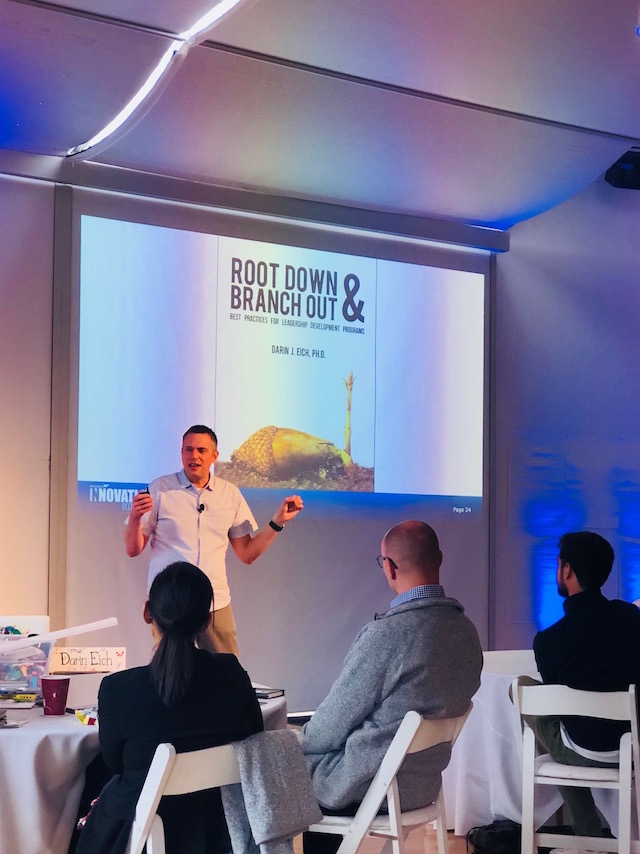
It has taken me many years of speaking, program development, and facilitation to learn these things and practice them in ways that become intuitive. I’ve been intentional about this approach for the past few years and I’m doing the most speaking/facilitation events (10) around the country this month that I’ve ever done so I feel that this approach is paying off. The programs go better and that equates to getting invited back and expanding to other conferences/events/organizations. Highly interactive SAM V presentations is my tip.

Posted in education, learning, speaking | Tagged , , , , , , | Leave a comment

Communicate like a Yoga Instructor

Do you ever find yourself needing to communicate an important new idea or concept so that it is understood quickly? Yoga instructors are the best at communicating complex ideas. They use all of the tools in the toolbox. You have to get it. If not, you might get hurt. Yoga instructors try to communicate a complex idea to you so that you take action on it right there and then. The concept they convey is a yoga pose that you need to situate your body into. You need to get it quick too, because you will be done with that pose and onto the next one in less than a minute.

Here are some things I’ve learned from yoga instructors on communicating your idea. Let’s say that the instructor wants you to hold a pose where you put your feet into the ground, stretch your gastrocnemius muscles, bend at the hips, straighten your back, separate your shoulders out, slightly bend your arms, plant your fingers into the floor, all while breathing deeply and focusing your mind just on the present moment of the pose. They know better than to just tell you to do that in the words I just used. This is too complicated. Many also know better than to ask you to do Adho Mukha Svanasana. That is a Sanskrit pronunciation. Do you know Sanskrit? I didn’t think so.

Here is where it gets good. The instructor has to help you get this complex idea within seconds. So, luckily these yoga poses were named well. They were named using the power of metaphor. Adho Mukha Svanasana means “downward-facing dog.” Even before I did my first yoga pose my mind conjured up an image of man’s best friend stretching out in the way they love best. I knew what this seemingly complex movement, Adho Mukha Svanasana, generally looked like because I had seen a downward facing dog stretching before! That image was in my mind…the word Adho Mukha Svanasana wasn’t. The yoga instructors use the power of metaphor to describe the pose to help you understand what it might look like. These poses were named well. Take a look at the names of some of the classic yoga poses, you will see they translate into metaphors…and you might guess how to do them.

Sanskrit Word—–>English Translation (Metaphor)
Adho Mukha Svanasana—–> Downward-Facing Dog
Ardha Chandrasana—–> Half Moon Posture
Bakasana—–> Crane Pose
Balasana—–> Child’s Pose
Bhujangasana—–> Cobra Pose
Chakrasana—–> Wheel Posture
Dhanurasana—–> Bow
Halasana—–> Plow
Padmasana—–> Lotus Pose
Utkatasana—–> Chair
Vriksha-Asana—–> Tree Pose

The metaphor may help the person doing yoga get the general idea. What is needed though is something to help them get the details. Here is how the yoga instructors help them do this. First, they show you. They will demonstrate the pose up front and talk you through it. You watch and do.

If showing you themselves isn’t enough the yoga instructor has constructed an environment in the studio to help you learn from others. You are in close proximity to them, sometimes only inches away. You do yoga with other people that know these poses. If you are still confused they encourage you to look at the person in front of you that knows what they are doing. They utilize the power of others as co-teachers. You watch others and learn.

If you still don’t get it the instructor will talk you through it. They give you specific feedback on what it is that you need to do that you aren’t doing. It is laser focused. They again use the power of metaphor by perhaps sharing an analogy to coach you through it and help you understand, such as “hinge at the hips” or “plant your hands into the mat” and “root down.”

Finally if you still don’t get the idea the instructor will use the greatest tool they have. The hands-on adjustment. They will come over to you and physically help move you to where it is you need to go. Sometimes we just don’t get it. This guarantees we will get it. There is so much to get.

Yoga instructors use the tools of metaphor, demonstration, letting you observe and learn from others, focused feedback, coaching with analogies, and hands-on adjustment to help you learn & do something complex like Adho Mukha Svanasana. The next time you have an important idea or concept to communicate to someone for the first time, think about how a yoga instructor might help that person learn and do.

Posted in learning, speaking, training | Tagged , | Leave a comment